Address
804, 805, 8th Floor, Tower B4, Spaze I Tech Park Sec-49, Sohna Road, Gurgaon-122018 , Haryana, India.
Download Alpha Portfolio App


Download Consolidated Portfolio App
Social Media



By Alpha Research
Apr 10, 2026


Its Day 40 of the US–Iran Conflict. War is typically discussed in moral, humanitarian, and geopolitical terms. It should be. Wars cause immense human suffering and disruption.
Yet for investors, ignoring the economic mechanics of conflict creates blind spots. War is one of the most powerful forces of capital allocation in modern history. It reshapes fiscal policy, restructures industries, accelerates technological change, and redistributes global capital.
Treating wars as too uncomfortable for investment analysis does not reduce risk; it simply makes risk invisible.
We are living through a structural shift in geopolitics. The post–Cold War assumptions of cooperative globalization, declining defense budgets, efficiency-driven supply chains, and US unipolarity are being replaced by a fragmented, security-focused, multipolar world.
In such an environment, governments prioritize resilience over efficiency, domestic capability over global dependence, and strategic autonomy over cost minimization. This transition produces economic disruption, but also long-duration investment opportunities. For investors, the objective is not to predict wars but to understand how wars restructure economic systems.
A phrase popular among economists: 'markets allocate resources efficiently.' That is largely true in peacetime. War is the great exception. When conflict escalates, fiscal priorities change rapidly, and the state becomes the dominant buyer.
During World War II, US defense spending rose from 1.6% of GDP in 1940 to over 37% by 1944, while Britain spent roughly half its economic output on the war effort.
When governments command such a large share of economic output, industrial ecosystems realign. Defense companies benefit first, but the more significant transformation occurs in surrounding industries such as metals, semiconductors, logistics, electronics, chemicals, and energy.
Supply chains are rebuilt, production capacity expands, and technological standards rise. Wartime procurement compresses decades of industrial evolution into a few years, and sectors that were peripheral in peacetime become central to economic activity.
The single most underappreciated economic consequence of war is its role as a forced accelerator of foundational technology. Governments fund research unconstrained by short-term commercial returns, allowing innovation to occur at a speed markets rarely support. Radar, jet engines, nuclear energy, digital computing, GPS, and the internet all emerged from military R&D programs later commercialized by private industry.
Modern conflicts are accelerating a similar set of technologies - drones, satellite intelligence, cybersecurity infrastructure, AI-enabled defense systems, and advanced materials. As warfare becomes increasingly technology-driven, defense innovation spills over into civilian industries, creating new platforms for long-term growth.
Financial markets respond to war in ways that often contradict intuition. The initial phase is typically marked by uncertainty and volatility, followed by adjustment as the economic implications become clearer. After Pearl Harbor, stocks fell briefly but recovered quickly. During the Gulf War, oil surged ahead of the conflict and fell once military action began.
Markets price uncertainty more than conflict itself. Once the path of fiscal spending, supply disruptions, and policy responses becomes clearer, capital reallocates. Wars also reshape market composition. Companies that were previously marginal become central, particularly in defense, energy, logistics, cybersecurity, and strategic manufacturing. Conversely, sectors dependent on low inflation, stable supply chains, and low interest rates often face pressure.
Wars are structurally inflationary. Massive fiscal expansion, supply disruptions, and commodity price shocks combine to push prices higher. The earliest signals typically appear in oil and gold, but the decisive variable is the interest-rate response.
Oil behaves differently, reacting immediately to supply risks, particularly in geopolitically sensitive regions. Oil sits at the intersection of the real economy and the financial system. It is priced in dollars globally, which creates a structural inverse relationship: a stronger dollar makes oil more expensive in other currencies, suppressing demand and prices.
This is why petrodollar dynamics remain central to understanding capital flows (Read more about it here). More importantly, oil functions as an early warning system, as supply disruptions in major producing regions almost always precede broader inflationary episodes because energy costs are embedded in the production cost of virtually everything.
Gold performs best when real yields fall, and the opportunity cost of holding it declines. If central banks respond to wartime inflation with aggressive tightening, gold can weaken even during conflict.
Treasury markets become central in wartime dynamics, as governments issue debt to finance spending while investors simultaneously seek safety. The interaction between fiscal expansion and bond yields then drives cross-asset performance across equities, commodities, and currencies.
The US–Iran conflict is economically significant primarily because of geography. Iran sits near the Strait of Hormuz, through which roughly one-fifth of global oil supply flows. Even the risk of disruption affects energy prices, shipping costs, and insurance premiums.
The transmission mechanism typically unfolds in sequence: initial market panic, followed by oil price volatility, inflation repricing, central bank response, and eventual equity sector rotation. Additional spillovers include tightening dollar liquidity, capital flows into safe-haven assets, and volatility in emerging markets. These second-order effects often matter more than the conflict itself.
India occupies an interesting position within this evolving geopolitical landscape. India is the world's largest democracy and the fourth-largest economy. It sits at the intersection of defense manufacturing, supply chain diversification, and strategic balancing across major powers. India's defense spending has been rising, alongside policy initiatives to boost domestic manufacturing and export capabilities. Defense exports have increased sharply over the past several years, reflecting a structural shift in the industrial base.
At the same time, India's geopolitical flexibility allows it to maintain relationships across competing blocs while benefiting from supply chain realignment. In a fragmented world, such optionality becomes economically valuable. It can translate into long-term investment opportunities across defense, manufacturing, and strategic sectors.
Beyond defense and commodities, wars generate less obvious economic spillovers. The most important is the transition from efficiency-driven globalization to security-driven supply chains. For decades, the global economy optimized for cost through just-in-time manufacturing and offshoring. That model is now being repriced.
Governments are funding semiconductor capacity, domestic energy production, and resilience in strategic manufacturing. These are multi-decade capital expenditure cycles. Wars also accelerate automation and remote operations. Modern conflicts are increasingly driven by drones, sensors, and software, shifting defense spending toward digital infrastructure. At the same time, cybersecurity has become a critical national infrastructure, with governments treating cyber resilience as a core defense priority.
Wars, however, do not automatically produce favorable outcomes for markets. The risks are significant. Policy tightening in response to inflation can produce stagflation. Rising fiscal deficits can push bond yields higher, pressuring equities. Oil shocks can eventually suppress demand. Dollar strength can trigger capital outflows from emerging markets. Liquidity conditions can tighten rapidly. The economic outcome depends on how governments and central banks respond to these pressures.
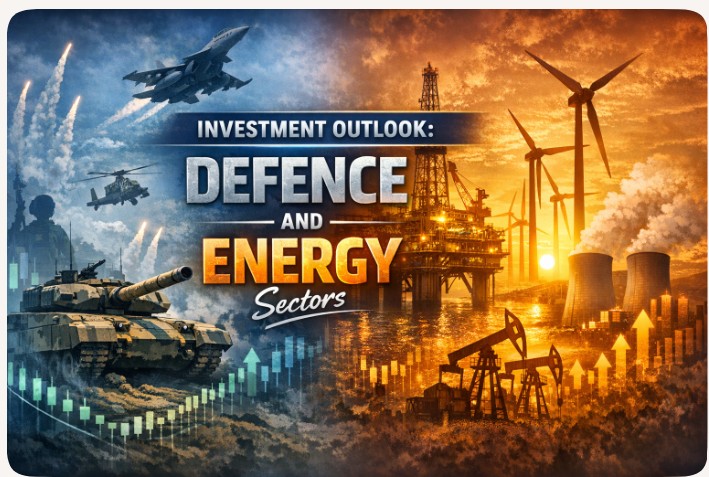
For investors, the implication is to focus on structural capital allocation rather than short-term headlines. Defense and defense technology sectors tend to benefit from sustained government spending and modernization cycles. Energy and strategic commodities gain from supply risks and security-driven investment. Cybersecurity and digital infrastructure are increasingly supported by government procurement. Industrial and strategic manufacturing sectors benefit from supply chain diversification. India-focused defense and manufacturing ecosystems stand to gain from policy support and geopolitical positioning.
At the same time, rate-sensitive assets and highly leveraged sectors remain vulnerable if bond yields rise. Monitoring real yields becomes critical for assessing gold, equities, and risk appetite, while maintaining liquidity allows investors to take advantage of volatility-driven dislocations.
My dear readers, remember the consistent lesson across history is that where governments spend persistently, industries eventually flourish. Wars are tragic human events, but economically, they are powerful forces of restructuring. Investors who understand the direction of capital allocation can better navigate volatility and identify the sectors that emerge stronger in the world that follows.
The number on the screen is never the answer.
The question is always: what is causing this number to be what it is?
Best Regards
Dr. Tarunika Jain Agrawal Ph.D.
Alpha Research
Disclaimer: The information on this document is provided for information purpose only and is available in the public domain. It does not constitute any offer, recommendation. The views expressed by the Alpha Capital Research are based on current market conditions and information available publicly