Address
804, 805, 8th Floor, Tower B4, Spaze I Tech Park Sec-49, Sohna Road, Gurgaon-122018 , Haryana, India.
Download Alpha Portfolio App


Download Consolidated Portfolio App
Social Media



By Alpha Research
Aug 05, 2023


The United States of America, often considered an economic powerhouse, has always stood as a symbol of stability and financial prowess. However, this week the nation has faced a unique challenge that shook the global economic landscape - a rating downgrade.
Rating Company, Fitch, downgraded US debt from the highest AAA rating to AA+, citing "a steady deterioration in standards of governance" as a significant reason.
A sovereign credit rating assesses a country's ability to honour its debt obligations and reflects its overall economic stability. Several prominent credit rating agencies, such as Standard & Poor's, Moody's Investors Service, and Fitch Ratings, are responsible for evaluating and assigning sovereign credit ratings.
These agencies employ comprehensive methodologies and data analysis to provide a well-rounded evaluation, including fiscal policies, economic growth, external debt, political stability, and governance standards. The rating is expressed through letter grades, similar to corporate credit ratings, but with unique implications for countries on the global stage.
The highest rating is usually denoted as "AAA" or "Aaa," representing a low-risk investment. Ratings then descend through "AA," "A," "BBB," "BB," "B," and so on, indicating higher risk and lower credit quality. The lowest rating, often labelled as "CCC," "C," or "D," suggests that the country is in or near default.
In the past, in August 2011, Standard & Poor's (S&P), one of the major credit rating agencies, downgraded the rating of the US from AAA to AA+. It was the first time in history that the US rating was downgraded from its perfect AAA status for nearly a century.
Mounting national debt, prolonged budgetary deficits, and a lack of consensus among policymakers on crucial economic and financial matters contributed to this predicament. Credit rating agencies, responsible for evaluating a country's creditworthiness, noted these concerns and downgraded the US's credit rating.
The 2011 rating downgrade was pivotal. It questioned the US's role as the world's economic superpower. Investors perceived the US as a riskier borrower. Interest rates on government debt increased, putting additional strain on the already burgeoning national debt. Investor confidence wavered, sending shockwaves through global financial markets, causing heightened volatility and uncertainty.
Global equity markets were affected by the massive selling of stocks and investors seeking safer assets. In the aftermath of the downgrade, the US made concerted efforts to regain its economic resilience and reaffirm its position as a global economic leader.
How is the present situation different from the past?
Public debt levels of the US have been rising consistently (and faster), resulting in a rating downgrade for the US once again (History repeats itself!!)
The US is one of the 20 countries with the highest public debt levels, accompanying other countries like Japan (with the highest debt levels and rated A by Fitch); Greece (which was once on the brink of default); Venezuela and Sudan, which are grappling with the problem of high inflation (or hyperinflation).
Now, with elevated government debt, the rise in interest rates is weighing on growth and fueling financial stability risks.
Inflation rate and Federal Reserve interest rate monthly in the United States from January 2018 to June 2023:
We all have seen the side effects of the rise in interest rates since the beginning of 2023. Monetary policy tightening caused problems for banks with considerable exposure to government bonds, as in the case of Silicon Valley Bank. The rapid spread of news about bank fragility ("the first Twitter-fuelled bank run") triggered unprecedented deposit outflows, leading to bank failure.
The US rating downgrade served as a wake-up call, underscoring the significance of sound fiscal management and policy coordination.
Notably, foreign ownership of US debt, which includes governments and private investors, is much higher now than it was about 50 years ago. Investors in Japan and China hold significant shares of US public debt. Increased interest payments to foreign holders potentially reduce national income and increase the risk of a crisis.
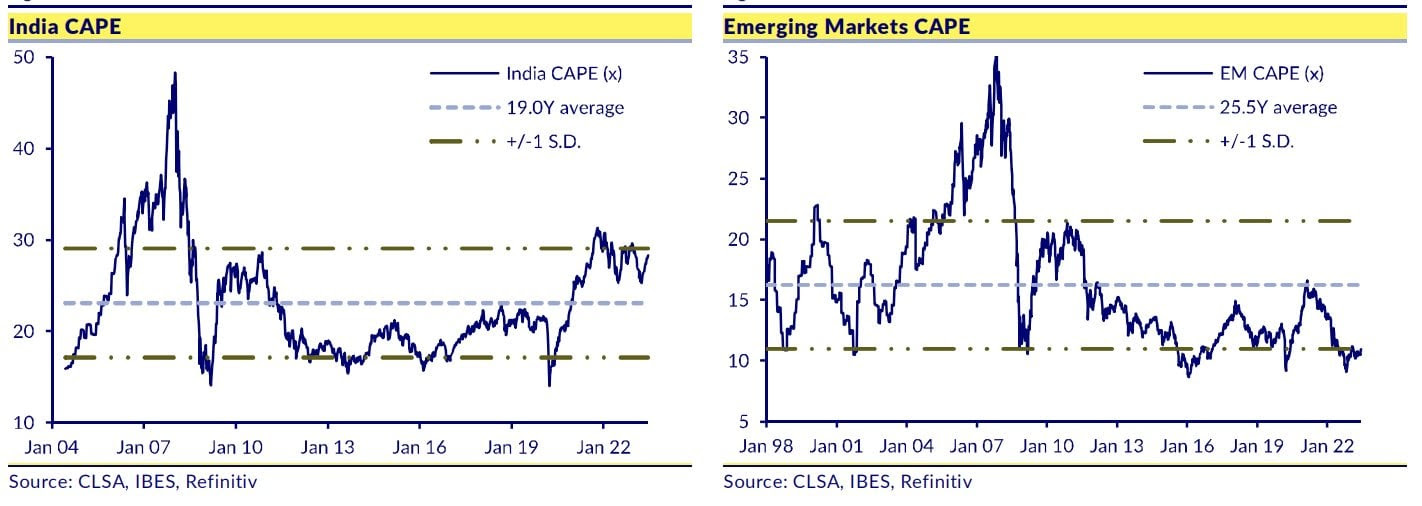
Further, more recently, Morgan Stanley has upgraded Indian equities to 'overweight', now the most preferred market in the Asia Pacific.
So my dear investors, while this ditch of the US by Fitch may be an early warning signal to be wary of the rising debt levels, as investors we can continue to be bullish on the Indian Stock Markets as the spillover effect is likely to be minimal.
Let's not miss opportunities to build sensible positions.
Best Regards
Dr. Tarunika Jain Agrawal Ph.D.
Alpha Research