Address
804, 805, 8th Floor, Tower B4, Spaze I Tech Park Sec-49, Sohna Road, Gurgaon-122018 , Haryana, India.
Download Alpha Portfolio App


Download Consolidated Portfolio App
Social Media



By Alpha Research
Apr 20, 2022


Greatness is the byproduct of a person’s exceptional qualities and behavior. Legendary investors are the greatest ones only because of the unique investing strategies they acquired by spending years on trial and error, market analysis, and research. Their exceptional skills, without doubt, turned them into some of the wealthiest persons on this planet.
Legendary investors eat and sleep with the markets. With their years-long hard work and patience, they have absorbed the market behavior in their heads. So, it is no wonder that every retail investor secretly wishes to follow the legends’ investment success (blindly, without making any effort) to strike it big in no time.
Reality never turns much rosy as our imaginations. Every individual possesses unique cognitive abilities, skills, and talents in the real world, which means we are entirely different. Therefore, whenever we try to emulate someone, we put a psychological limit on ourselves, and this will eventually halt us from making our own decisions or being creative in our style. More importantly, people who try to make a fortune by copying others will turn into losers in the long run. Luckily, we have got a brain, and it is our responsibility to put it to work!
Michael Burry, a physician, and a legendary American hedge fund manager, once stated that Warren Buffet didn’t copy the investing style of his mentor, Ben Graham, despite he got the opportunity to do so. Instead, Warren Buffet chose to pave his own path and managed money his way by abiding by his own rules.
This article discusses whether it will be good or not to copy successful investors’ portfolios or their investing strategies.
Does Portfolio Cloning work?
Everyone indeed fancies making money from the stock market. But, contrary to popular notions, portfolio cloning is not the right way to do it.
Portfolio cloning has been made famous by social media influencers and the people who make a living by giving stock market ‘tips’ to their clients. But unfortunately, several people claim to beat the stock market by portfolio cloning. In reality, they are just fraudsters.
You should consider that as retail investors, we are not equipped with the sophisticated tools for research and analysis like that of successful billionaire investors. Therefore, blindly copying their portfolio simply never works for retail investors.
Financial Goals Vary
Have you ever thought about the financial goals of legendary investors like Warren Buffett and Rakesh Jhunjhunwala? Do you think they have similar personal and financial goals as you do? Most probably, not!
Every investor enters the stock market with entirely different goals from another investor. So, expecting someone else’s investing decisions will help you achieve your financial goals is a myth.
More than that, investing is all about leading a life free from financial stress. Therefore, your priority should be to acquire stocks or other assets to help you meet your financial goals rather than copying a successful investor’s stock picks.
Investment Spans Vary
Big investors often invest larger chunks of money in stocks or other assets and stay invested for extended periods. This strategy often brings enormous returns for investors with deep pockets.
However, this long-term investment strategy with vast amounts of money never works for retail investors because the limits of their financial resources, financial goals, and risk appetites vary. For instance, to achieve a financial goal within a year, a short-term mutual fund investment will be the right pick rather than a stock market investment with an anticipated return of 15% in the next 5 to 6 years.
Risk Appetites Change
Why does risk appetite change? The risk of losing a thousand rupees is not the same for a person with a six-digit salary and a person who can barely make a living. Similarly, as risk appetite change from person to person, it also changes from investor to investor. It varies with age and the depth of an investor’s pocket.
An investor in his 40s prefers to finance their child’s education or create a retirement fund. As a result, he might not divert his earnings into the stock market but would invest in debt instruments for a steady revenue stream. On the other hand, a 20-something investor would prefer risky stock market investments across different segments and sectors.
The Trouble with Diversification
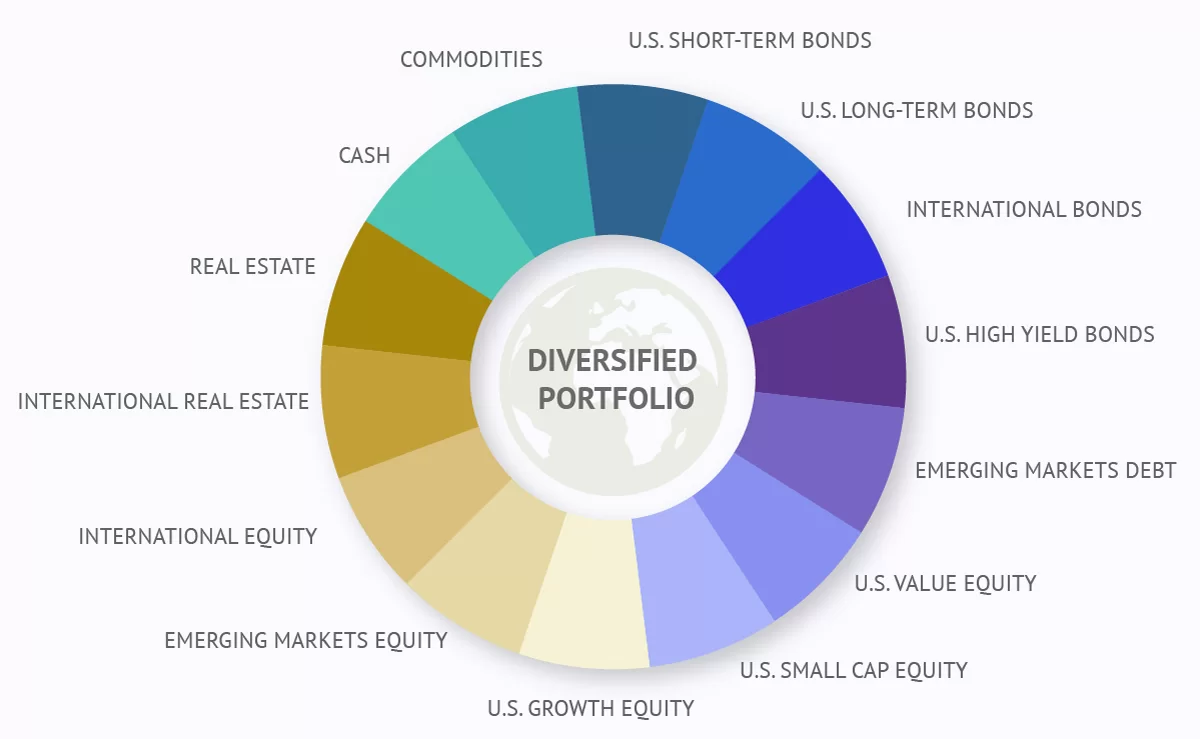
In theory, diversification is an investing strategy in which investments are made across different asset classes to avoid the risk of putting money in a single investment. In simpler terms, diversification is all about not putting all your eggs in one basket since a single mistake can make you lose all of it.
But, in reality, to put all your eggs in different baskets, of course, you need more baskets, and to own more baskets, you need to spend more money, and to spend more money, you must have more money!
The idea is quite simple. Big institutional investors diversify because they got plenty of money at their disposal, and a retail investor might not have such financial resources. So, simply copying an institutional investor’s portfolio or diversification tactics wreaks havoc on your investing.
The Timing Trouble
The entry-exit timing of big investors is often hidden from the public; mostly, it happens without your knowledge. The information regarding the interest of a prominent investor in a particular stock and the price at which they bought it is available only after they have taken the position in a specific stock.
For example, a successful investor named Varun bought 100 shares of a company called Nirvana at ₹100 per share. The information about his investment becomes known to the public only after making the investment. When the information is out to the public, he may purchase more with the retail investors. It may ultimately lead to the overvaluation of the stock owing to the sudden spike in demand. Therefore, the stock ceases to be a good return generating asset for a retail investor.
Conclusion
Anyway, looking through the portfolios of big investors would be helpful to generate profitable stock market investment ideas. Then you can pick the stock after an in-depth market and equity analysis.
To keep the long story short, investing, in general, is entirely subjective. That means an appropriate investment strategy for a prominent investor may not be suitable for you (and vice-versa). So, you should check your risk appetite, financial profile, and goals before jumping into investments and thoroughly plan the best investment strategy accordingly.
Justin Raj
Alpha Research
More From Blogs