Address
804, 805, 8th Floor, Tower B4, Spaze I Tech Park Sec-49, Sohna Road, Gurgaon-122018 , Haryana, India.
Download Alpha Portfolio App


Download Consolidated Portfolio App
Social Media



By Alpha Research
Jan 21, 2022


For generations, Indians have been in love with their past, traditions, folklore, and fairytales. Besides, they never shy away from filling their portfolio with these never-ending love affairs. A portfolio based on bedtime grandma stories and traditional investment assets do not, and cannot, generate returns that could, at least, beat the rate of inflation. Unfortunately, millions of Indian families possess portfolios with poor asset allocation. That also means millions of Indians are heading towards their retirement with depleted portfolios.
A Reserve Bank of India (RBI) report in 2017 stands as the proof for the above-mentioned fact. The ‘Indian Household Finance Survey’ by RBI published in July 2017 highlighted that the average Indian household holds nearly 84% of its wealth in real estate and other physical assets, roughly 11% in gold and other precious metals, and a meager 5% in financial assets. Even at the creamy layer of wealth distribution, retirement investing plays a very limited role in the balance sheets of Indian households. The report also states that households in advanced economies hold substantially more financial assets than their Indian counterparts. They are more likely to finance home purchasing with a mortgage and hold a major part of their wealth in retirement funds throughout their lifetime.
Although the RBI survey revealed shocking statistics, the reality is much worse. Most Indians, including affluent Indian High Networth Individuals (HNIs), have allocated over 95% of their wealth to assets that fail to generate a real rate of return. Those assets include gold, real estate, substandard debt mutual funds, and low-quality stocks. Therefore, the situation is turning grim for a generation of Indians, who began working in the early 1980s and waiting to retire in the next ten years, set to struggle mightily through their retirement phase of life.
It is important to take note of how this financial disaster takes place and at the same time, it is vital to mitigate the financial ruins these disasters are about to bring in millions of Indian HNI families and businesses. Towards both ends, this write-up should deflate a few of the Indian investing myths that have been wreaking havoc on the financial wellbeing of Indians for generations.
Myth 1: Gold is the Protector of Wealth
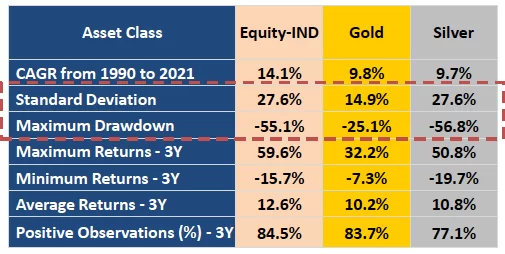
Well, in India, gold can be a reliable store of value because the gold’s price in terms of Indian rupees has compounded at 5 percent annually over the last 30 years. This return is broadly on a par with the prevalent rate of Consumer Price Inflation (CPI) in the country. But as far as increasing your wealth is concerned, gold is not an asset to look out for. The record of gold’s price over the past three decades shows that it could generate returns below the rate of inflation. Between March 1990 to March 2000 gold prices fell 2.7 percent per annum and it witnessed a price rise of a meager 3.5 percent between March 2010 to March 2020.
Well, gold cannot augment your wealth materially after taking into account the rate of inflation. But, will it ever improve the risk-reward ratio in an Indian HNI’s portfolio? In other words, will it help Indian investors to diversify their portfolios?
An effective diversifying asset should possess zero or negative correlation to the markets like NIFTY or Sensex. If we analyze the yearly change in prices of gold and Sensex in terms of each month from March 1990 to March 2020, we can easily find out that the two assets have a positive correlation of 12 percent. This price analysis might ring a bell or two to those who consider gold as a ‘safe-haven asset’, especially when stock markets or specific stocks are under pressure. Even during the 2008 financial crisis and the Corona panic from February to April 2020, gold and the Indian stock markets keep up their positive correlation. A simple price chart analysis of both assets during that period can validate this fact.
Myth 2: Real Estate Can Grow My Wealth
Real estate investments are not worth the price and the risk. There are three major reasons to back that fact as well. Firstly, over the past five years, the returns of real estate properties even in metropolitan cities in India such as Mumbai, Delhi, and Bangalore have been roughly around 3-4% per annum – a rate of return that can easily be eaten away by current CPI. Secondly, the current home loan interest rate in India stands at 7.5%. Therefore, investing in an asset that yields a meager 3-4 percent on a 7.5% interest rate is not a wise investment decision. Thirdly, there is no point in comparing Indian residential rental yields with the same in other countries. Setting aside the affordability factor, countries like Singapore and USA offer real estate finance at an interest rate of 2-3%.
Myth 3: Debt Mutual Funds Offer Better Returns with Low Volatility
Debt mutual funds indeed offer better returns with low volatility. But, in India, the problem arises from the salesmen who earn a living by selling mutual funds. They have popularized the idea that mutual funds are the right investment class (with market-beating returns) for HNIs. Despite the news of the poor performance of even prominent mutual funds, the intermediaries continue to sell such products successfully. Why?
The blame should be placed on the reluctance of the investors to analyze and validate the right mutual fund for themselves. An investor should invest some time to analyze the Yield to Maturity (YTM), Mark to Market (MTM), and Expense Ratio, the factors that determine the return of a mutual fund. A little bit of time and effort spent on analyzing these factors and overall market conditions can help an investor to pick out the mutual funds that offer better returns with low volatility from high-risk, sub-standard funds.
Myth 4: I Can Time the Stock Market
No one can either time the stock market or the economic cycles. Besides, contrary to popular Indian notion, Gross Domestic Product (GDP) growth never drives the stock market. Most of the investors give a portion of their wealth (or all of it) to an investment analyst in the hope that the analyst can perfectly time the market or the economy. And in most cases, the hope never gets fulfilled. In truth, stock markets are more or less a reflector of the collective investor psychology that may act as a predictor of GDP growth. The economic cycles or GDP growth seldom play a role in equity market returns.
Consistent Compounding Approach Is the Key
Anyway, we have debunked the major myths surrounding Indian investing. Now is the time to reveal some investment methods that work. We have already mentioned investing a good amount of time and effort before embarking on an investment journey. Choosing a genuine investment analyst who makes a living on fees and a share of profits can do wonders.
Another way to generate significant returns is by investing in a consistent manner. This means, investing in high-quality yet well-managed Indian companies that sell essential products and services with little market competition or behind a strong economic moat. This is also known as the Consistent Compounding approach, an investing approach that works, both in theory and in practice.
– Justin Raj
Alpha Research Team
More From Blogs