Address
804, 805, 8th Floor, Tower B4, Spaze I Tech Park Sec-49, Sohna Road, Gurgaon-122018 , Haryana, India.
Download Alpha Portfolio App


Download Consolidated Portfolio App
Social Media



By Alpha Research
Sep 08, 2025


Recently, I was schooled by my teenage daughter on the nuances of digital etiquette. Apparently, the humble "" emoji — which I liberally scatter in chats to signal approval — no longer symbolises encouragement. Instead, in her world, it represents passive-aggressive detachment, the digital equivalent of a polite but dismissive nod.
It struck me how this generational shift in perception reflects something bigger: meaning is not always apparent; it often hides in the subtext, the unsaid, or the nuanced.
That thumbnail observation stayed with me because the same pattern — tacit, calibrated, sometimes intentionally ambiguous — now appears on India's global stage. India's diplomacy and policy choices have become, in effect, a geopolitical thumbs-up: deliberate, strategic, non-committal in public but meaningful in practice.
For investors, the key question is not theatre; it is causality: how do those calibrated moves flow into growth, corporate earnings, balance sheets, and the risk premium demanded by global capital?
I attempt to synthesise the latest macro readings, the geopolitical shocks of mid-2025, policy reactions and the practical investment playbook that emerges.
The Twin Realities of India: Macro Resilience vs. Geopolitical Friction
Two truths coexist and both shape investment strategy.
Truth A: Economic strength remains solid. High-frequency data in mid-2025 is robust:
Rather than narrative alone, it's the key numbers the market should care about.
Truth B: Geopolitics is an economic headwind. India is in the eye of a geopolitical storm that matters economically.
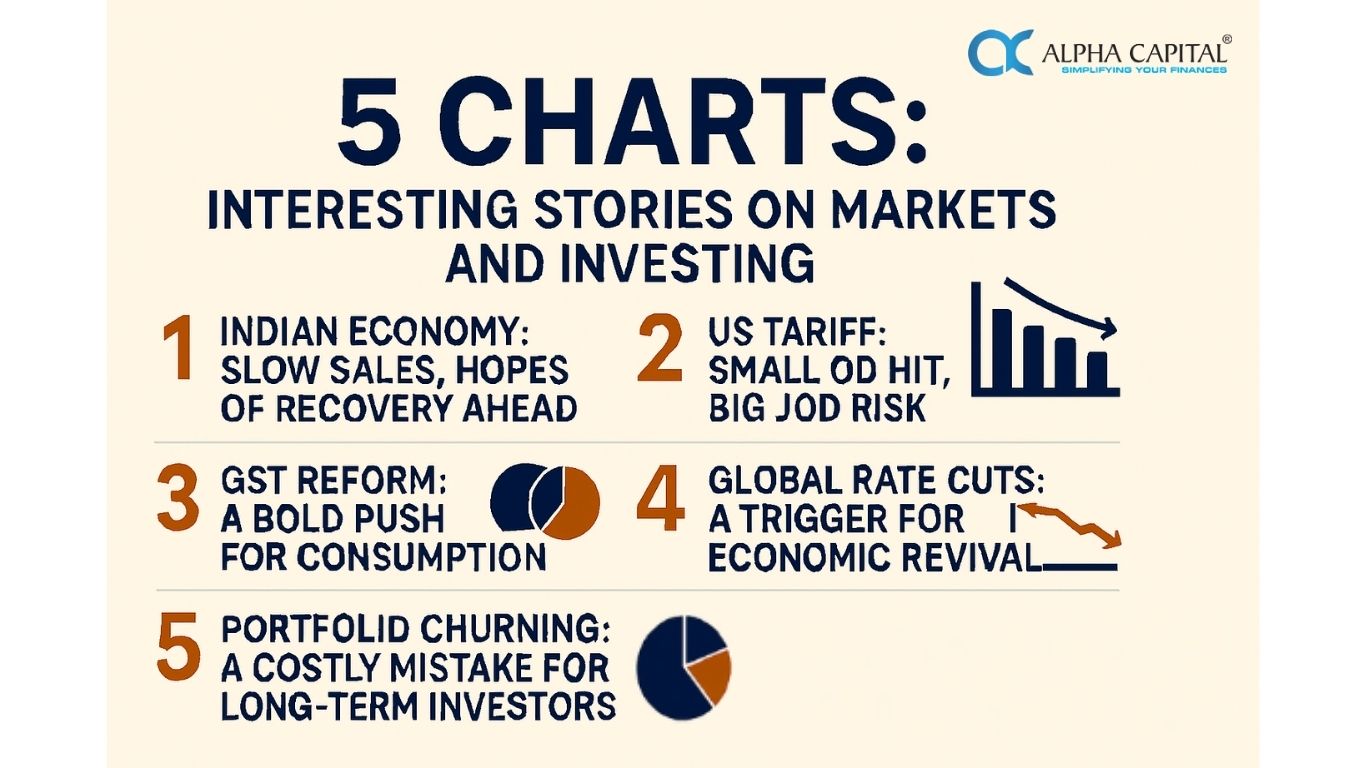
The relationship between India and the United States has recently deteriorated, culminating in a series of punitive economic measures that have evolved into a broader strategic standoff.The U.S. has escalated tariffs to 50% on Indian goods, hitting $60.2 billion worth of exports — a blow to textiles, gems, jewellery, leather, and seafood. Economists expect a 0.4–0.5% drag on FY26 GDP.
The shock is concentrated, but not trivial. The tariffs represent one of the sharpest blows to India-U.S. ties in decades. The tariffs, framed as punishment for Russian oil imports, also reflect Washington’s irritation at India’s refusal to play by U.S. strategic rules.
For India, the immediate challenge is concentrated: $55–60 billion of exports are exposed, and millions of jobs are at risk in MSME-heavy sectors.
Agriculture remains off the table; no Indian government can risk opening it to imports, given 250 million farmers' dependence on it.
The May 2025 India-Pakistan conflict highlighted India's enduring vulnerabilities. Operation Sindoor saw Indian missile strikes on militant camps; Pakistan retaliated by suspending the Simla Agreement and trade, while India froze the Indus Waters Treaty.
India's "Neighbourhood First" policy is being tested. Still, New Delhi is countering with fresh agreements like those with Bangladesh on border security and a maritime security pact with Fiji, leading to stronger Indo-Pacific partnerships.
In response to the substantial economic challenge posed by the U.S. tariffs, the Indian government has ruled out direct retaliation. Instead, it has adopted a proactive multi-pronged strategy to absorb the shock and reposition its economy.
Policy Support: Fiscal and Monetary Cushion
This includes exploring domestic measures such as considering a ₹25,000-crore Export Promotion Mission to provide financial and regulatory support to affected sectors.[xiii] It should limit bankruptcies and manage liquidity stress. Though these schemes may be small in GDP terms (<0.1% direct fiscal cost), quantitative easing for exporters helps preserve employment and sentiment.
Additionally, to cushion the slowdown, the government and RBI have rolled out a flurry of pro-growth measures[xiv]: Aggressive monetary easing results in lower rates, which would help debt serviceability and corporate earnings, but could put upward pressure on currencies in specific global risk-off episodes. A few more relate to
Yet, while these policies may lift consumption and investment, they also risk further dampening inflation, complicating the growth-revival challenge ahead.
September 2025 marks a turning point with GST Reform 2.0. At the 56th GST Council meeting, the government collapsed the four-tier system into three slabs, scrapping the 12% and 28% rates. Most goods now fall under 5% and 18%, while sin goods moved to 40%, and essentials such as dairy, stationery, and health insurance were made GST-free.
Effective from 22nd September 2025, the timing is symbolic — coinciding with the start of Navratri, a festival associated with consumption. This reform signals a pivot from capex-led growth to consumption-led revival. After a decade of infrastructure-heavy budgets, the focus is shifting toward rural households and the middle class, putting more money in consumers’ hands.
Expected sectoral winners: FMCG, autos, cement, consumer durables, insurance, and retail and losers include luxury cars and aerated drinks.
Externally, the government is pursuing a targeted outreach to 40 key markets, including the United Kingdom, Japan, and European nations, to diversify its export base away from the United States.
India's foreign policy today is neither old-school non-alignment nor blind alignment. It is what many diplomats now call 'multi-alignment' — a deliberate attempt to engage deeply with competing power blocs without being absorbed by any one of them. This balancing act strengthens India's flexibility, opening doors on multiple fronts.
If GST 2.0 is expected to redefine the domestic playbook, the Shanghai Cooperation Organization (SCO) Summit in Tianjin (Sep 2025) resets India’s geopolitical signalling. The visit focused on connectivity via the International North-South Transport Corridor (INSTC). India also invited Xi Jinping to the 2026 BRICS summit in New Delhi, underlining the leadership of the Global South.[xx]
All in all, India's strategic autonomy is visible in its multilateral engagement. India is equally at BRICS, SCO, and G-7 tables, signalling its “multi-alignment” — engaging with all blocs without belonging fully to any.
Market Implications: Resilience Amid Noise
Despite tariffs and a slowing nominal GDP (8% in FY25, lowest in decades outside Covid years), Indian capital markets remain resilient. Consumption stocks remain buoyant as investors rotate away from cyclical capex bets.
At the same time, the SIP-driven culture of steady equity investing continues to deliver record inflows of ₹548bn into mutual funds and ₹285bn via SIPs in July alone.
True, SMEs in tariff-hit sectors face headwinds. Still, market consolidation only strengthens large players across autos, banks, cement, and telecom. With mutual and pension fund participation deepening and domestic investors holding firm, India is emerging as perhaps the most dynamic capital market outside the United States.
Sector Winners and Losers

India's digital transformation has also created breakthroughs in fintech, SaaS, and AI sectors. The startup ecosystem, home to the world's third-largest unicorn count, continues to attract venture capital, especially in emerging technologies like AI, cybersecurity, and blockchain.
Risks to Monitor
Any relaxation of US-China trade tensions could diminish India's relative advantage in supply chain diversification. Regional volatility in the Middle East risks disrupting energy supplies and remittance inflows from Gulf nations.
Domestically, infrastructure deficits, bureaucratic inertia, labour market rigidities, judicial delays, and uneven policy execution continue to pose challenges. Indian equity valuations at 22x forward P/E exceed those of emerging market peers, reducing downside buffers in an uncertain global environment.
Risk management is the investor's primary duty. Here are the tail and medium risks to monitor - Tariff duration & escalation; Global commodity shock (oil); Policy mis-execution domestically; Global risk-off & capital flows.
My dear readers, the message is clear. India's thumbs-up diplomacy is not hesitation but calibration. By refusing to be boxed into binary alignments, it accepts noisy short-term frictions in exchange for long-term optionality (supply-chain relocation, manufacturing scale, green energy leadership).
In the longer term, the tariffs push India toward greater strategic autonomy — pivoting to Europe, strengthening ties with Japan, and cautiously opening channels with Beijing.
In a fractured world, subtle persistence may be India's greatest strength. This gets validated by recent U-turn by Donald Trump, on September, 6. 2025, when he acknowledged a special relationship between US and India after declaring the US had “lost India to China”.
As my daughter reminded me, a "thumbs-up" is not always what it seems. In India's case, that very subtlety is why it remains one of the most compelling investment destinations of our time.
Best Regards
Dr. Tarunika Jain Agrawal Ph.D.
Alpha Research
Disclaimer: The perspectives provided reflect our expectations of the economy, market, and investments, which may or may not materialize. Investors are encouraged to conduct their own due diligence before investing.